
news
*Oyo NUJ Muslim Community Holds Maiden Ramadan Lecture, Urges Purposeful Commitment to Islam, Completion of Central Mosque*

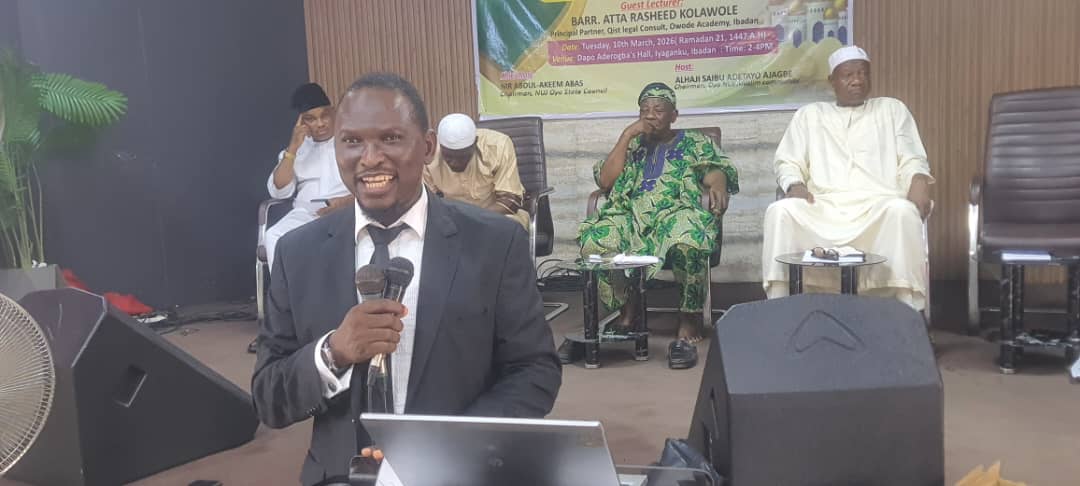
The Muslim Community of the Nigeria Union of Journalists (NUJ), Oyo State Council, held its maiden Ramadan Lecture, urging Muslim faithfuls to reflect on the lessons of the holy month and demonstrate stronger commitment to the teachings of Islam.
The event, held inside the Dapo Aderogba Hall, Iyaganku, Ibadan, brought together journalists of Muslim extraction, neighbours and other regular worshippers who observe congregational prayers at the NUJ Central mosque.
The gathering attracted notable personalities including the Chairman of the NUJ Oyo State Council, Mr. Akeem Babatunde Abas, the immediate past chairman of the council, Mr. Demola Babalola, and a veteran journalist, Alhaji Kola Animashaun, who served as the chairman of the occasion.
Also present at the lecture were a House of Representatives hopeful and retired General Manager of Radio Nigeria’s Premier FM, Alhaji Bashir Omotoso, as well as an insurance expert, Alhaji Lukman Lanre Oyeniyi.
Speaking, Oyo NUJ Chairman, Mr. Akeem Abas, reaffirmed his administration’s commitment to promoting discipline, professionalism and good governance within the journalism profession.
Abas also emphasised the importance of religious harmony within the council, noting that the union would continue to support initiatives that strengthen unity among members irrespective of religious affiliations.
He disclosed that the ongoing construction of the NUJ Mosque at the Press Centre would, upon completion, serve as a spiritual hub for Muslim journalists to worship, reflect and foster unity.
Delivering the Ramadan Lecture titled “The Growth of Islam in the Community: Our Responsibilities and Expectations,” the Guest Lecturer, Mr. Attah Kolawole, Principal Partner at Qist Legal Consult, Ibadan, urged Muslims to exemplify the values of Islam through good conduct and service to humanity.
Kolawole charged Muslim faithful, particularly journalists, to distinguish themselves through acts of charity, peace and integrity, noting that such virtues would help attract more people to the religion.
Earlier in his welcome address, the Chairman of Oyo NUJ Muslim Community, Alhaji Saibu Adetayo Ajagbe, called on well-meaning Nigerians and Muslim journalists to support the speedy completion of the NUJ Central mosque’s project.
In his appreciation, Chairman Ramadan Planning Committee, Khalid Imran thanked attendees who within shortest notice of invitation responded swifty to the religious gathering, praying Allah to grant their requests and make their participation as an act of Ibadah.


The Nigeria Union of Journalists (NUJ), Oyo State Council, held its monthly congress on Saturday, March 14, 2026, at the NUJ Press Centre, Iyaganku, Ibadan under the chairmanship of Chairman, Comrade Akeem Abas.
After reviewing developments within the union, the congress passed a vote of confidence on the leadership of Comrade Akeem Babatunde Abas and his executives for the remarkable achievements recorded within the first two months of their administration.
The congress commended Abas-led executives, describing the progress recorded so far as encouraging and reflective of purposeful leadership.
The congress particularly applauded the Akeem Babatunde Abas administration’s welfare packages, programmes, successful two-month training series that exceeded expectations, and the resuscitation of facilities at the Press Centre, which has restored orderliness and improved working environment within the council premises.
The council congratulated the Oyo State Government led by Governor Seyi Makinde on the successful hosting of the colourful 50th anniversary celebration of Oyo State, commending the administration for the developmental strides recorded across key sectors of the economy in the Pacesetter State.
While acknowledging these achievements, the congress expressed concern over the need for heightened security consciousness, urging government to adopt more proactive strategies aimed at strengthening the state’s security architecture and ensuring the protection of lives and property of the citizenry.
The council particularly lamented the rising incidents of cultism, hooliganism, incessant fights and the brandishing of dangerous weapons among students in secondary schools across the state, urging relevant authorities to take decisive measures, including sanctions against schools that fail to enforce discipline.
The congress stressed that parents must not abdicate their responsibilities in the upbringing of their children, urging them to play more active roles in instilling proper moral values and discipline in order to curb the growing social vices among youths.
On public safety and social welfare, the council commended the state government for investing in the Western Nigeria Security Network (Amotekun) Corps and the recruitment of 100 Fire Service personnel.
The congress however, charged government to ensure improved equipment, better welfare for operatives of these security corps to function efficiently and effectively .
It also called for sustained efforts to return out-of-school children to classrooms as well as urgent clearing of streams and rivers ahead of the rainy season to prevent flooding.
The congress also called for equitable distribution of developmental projects across towns and zones of the state.
news
*Finish Strong: Senator Buhari Commends Muslims And Christians, Urges Them To Persevere As Fasting Season Draws To A Close*
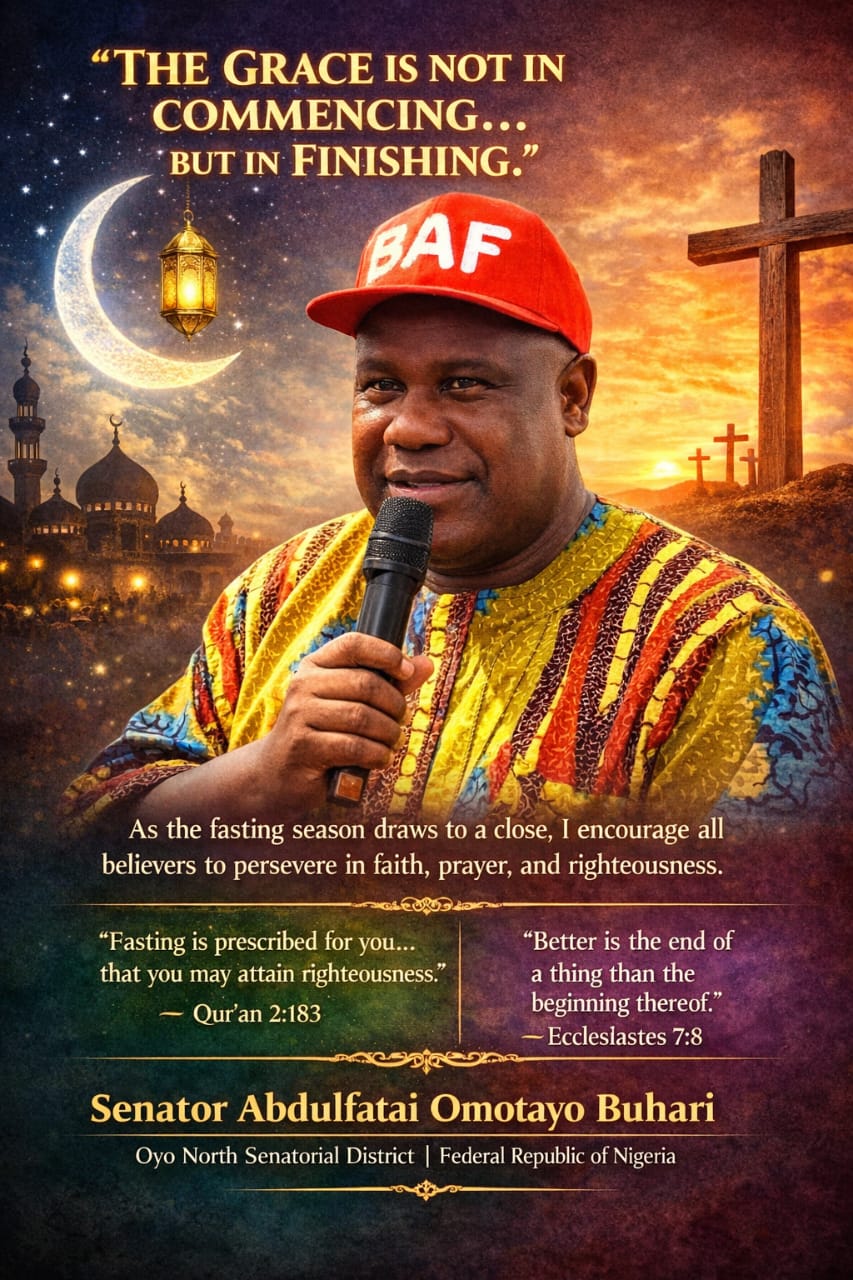
Senator Abdulfatai Omotayo Buhari has commended Muslim and Christian faithful across Nigeria for their steadfast devotion and obedience to the divine injunction of fasting as the sacred seasons of Ramadan and Lent gradually approach their conclusion.
In a goodwill message released through his media office, the Senator praised believers for their discipline, sacrifice, prayers, and acts of charity during the holy period, describing the observance as a powerful demonstration of faith, humility, and submission to the will of God.
According to Senator Buhari, fasting is a spiritual exercise that purifies the soul, strengthens moral character, and deepens the relationship between humanity and the Almighty.
Quoting the Holy Qur’an, he reminded the Muslim faithful of the purpose of fasting:
“O you who believe! Fasting is prescribed for you as it was prescribed for those before you, that you may attain righteousness.”
— Qur’an 2:183
He also cited a reassuring promise from the Qur’an:
“And whoever fears Allah – He will make for him a way out and provide for him from where he does not expect.”
— Qur’an 65:2–3
The Senator equally acknowledged the Christian community observing the Lenten season and encouraged them to remain steadfast in prayer, sacrifice, and reflection, drawing inspiration from the Bible:
“Let us not grow weary of doing good, for in due season we will reap, if we do not give up.”
— Galatians 6:9
He further noted the wisdom contained in the scripture:
“Better is the end of a thing than the beginning thereof.”
— Ecclesiastes 7:8
Senator Buhari emphasized that the spiritual lesson in both traditions is clear: the grace is not merely in starting a righteous journey but in finishing it faithfully.
He therefore urged both Muslims and Christians to persevere and remain spiritually committed as they approach the final phase of the fasting period, noting that the concluding days often carry profound spiritual significance.
The Senator prayed that Almighty God and Allah will accept the prayers, sacrifices, and acts of charity offered during the holy season and grant every faithful the desires of their hearts, while also blessing Nigeria with peace, unity, and prosperity.
news
*The Tinubu Enigma: Power, Strategy and the Nigerian State Part Three: The Kingmaker Doctrine – By Lanre Ogundipe*
In the previous installment of this series, Lagos was examined as the political laboratory where Bola Ahmed Tinubu constructed the foundations of his influence. Through fiscal reforms, governance restructuring and the gradual cultivation of political networks, Lagos evolved from a state administration into the base of a durable political structure. By the time Tinubu left office as governor in 2007, the system he helped build had demonstrated a rare quality in Nigerian politics: it survived the exit of its founder.Yet Lagos alone does not explain the full Tinubu phenomenon.The more intriguing phase of his political career began after his governorship ended. Instead of retreating into the background as many former governors do, Tinubu expanded his influence beyond Lagos and gradually emerged as one of the most consequential political strategists of the Fourth Republic. In this period, he acquired a reputation that would dominate political discourse for more than a decade: that of the kingmaker.The term was not accidental. It reflected the perception that Tinubu possessed an unusual ability to shape political outcomes without occupying the highest offices himself.Understanding how this reputation emerged requires examining the mechanics of influence in Nigeria’s evolving democratic environment.Following the restoration of civilian rule in 1999, Nigerian politics entered a prolonged phase dominated by a single national party. The People’s Democratic Party controlled the federal government and governed the majority of states. Opposition politics existed but remained fragmented, often divided by regional rivalries and leadership disputes.Tinubu’s political environment therefore required a different strategic approach. Rather than relying on ideological mobilisation or personal popularity alone, he gradually refined a method centred on coalition management and network expansion.The Lagos political structure provided the starting point.From that base, Tinubu strengthened alliances across the Southwest, consolidating political influence within a region that historically played a decisive role in Nigeria’s electoral dynamics. Party organisation, electoral coordination and the cultivation of loyal political actors helped establish a network that extended beyond Lagos itself.Over time, this regional consolidation produced a broader political role.One of the earliest demonstrations of this influence appeared in the emergence of political figures who rose to prominence through the Lagos system. The succession of Babatunde Fashola as governor of Lagos after Tinubu’s tenure drew national attention. Fashola’s technocratic style of governance and administrative reforms reinforced the perception that the Lagos political environment had developed a distinctive model of leadership cultivation.The pattern continued as other political actors associated with the Lagos network assumed influential roles in regional politics. Gradually, Tinubu’s influence came to be seen not merely as the legacy of a former governor but as the centre of a political machine capable of producing leaders.The concept of a kingmaker in democratic politics is not entirely new. In many political systems, influential figures operate as brokers of alliances, facilitators of coalitions and strategic organisers of electoral networks. Their influence lies less in holding office than in shaping the conditions under which others attain it.Tinubu’s political role increasingly resembled this model.Within the Southwest, he became a central figure in negotiating party alignments and coordinating opposition strategies. His ability to maintain relationships across multiple political actors allowed him to mediate disputes and sustain electoral cooperation among factions that might otherwise have competed against one another.This capacity for alliance management would later prove decisive.As the Fourth Republic matured, dissatisfaction with the dominance of a single ruling party began to grow across different regions of the country. Economic pressures, governance concerns and political rivalries gradually created conditions for opposition realignment.The possibility of a national coalition capable of challenging the ruling party began to emerge.It was within this shifting landscape that Tinubu’s kingmaker role became nationally visible.Opposition parties in Nigeria had long struggled with fragmentation. Multiple platforms existed, but their electoral strength was diluted by internal divisions and competing leadership ambitions. Tinubu became one of the figures advocating the consolidation of these disparate groups into a single political force capable of competing effectively at the national level.The effort eventually produced one of the most significant political mergers in Nigeria’s democratic history.In 2013, several opposition parties combined to form the All Progressives Congress. The merger brought together political actors from different regions and ideological backgrounds under a unified platform. For the first time since the return to civilian rule, a national opposition party possessed the organisational strength to challenge the ruling establishment.Tinubu was widely regarded as one of the principal architects of this coalition.The formation of the new party represented more than a routine political merger. It demonstrated the strategic value of the networks and alliances that had been cultivated over years of political engagement. Leaders who had previously operated within separate political platforms now found themselves part of a coordinated national project.Coalition politics had replaced fragmentation.The significance of this development became clear during the 2015 general election. The opposition alliance succeeded in achieving something unprecedented in Nigeria’s democratic history: defeating an incumbent ruling party at the federal level through the ballot box.The election of Muhammadu Buhari as president marked a turning point in the country’s political trajectory.Within the complex negotiations and alliances that produced that outcome, Tinubu’s influence was widely acknowledged. His ability to coordinate regional interests, manage coalition tensions and sustain political cooperation across diverse actors reinforced his reputation as a master strategist.The kingmaker narrative had become firmly established.Yet the kingmaker phase of Tinubu’s career contained an inherent tension. Political influence exercised behind the scenes carries advantages, but it also has limits. The strategist who helps others ascend to power inevitably confronts a question that political history often poses to power brokers.What happens when the kingmaker decides to become king?For many years, Tinubu’s role in national politics appeared to remain within the sphere of strategic influence rather than direct presidential ambition. He functioned as an organiser, negotiator and coalition builder. But political structures evolve, and ambitions often shift with changing circumstances.The years leading to the 2023 presidential election would bring that transformation into focus.By that time, Tinubu had spent decades constructing alliances, cultivating political networks and shaping electoral outcomes across multiple election cycles. The system that had once been built around Lagos had gradually expanded into a national network.The strategist had become a central figure within the political establishment he helped shape.When Tinubu eventually sought the presidency, he did so from a position that few Nigerian politicians had previously occupied. Unlike many candidates who rely primarily on popularity or elite endorsement, he possessed a long-established organisational base that extended across multiple regions.The kingmaker had built a structure strong enough to support his own bid for power.This transition represents one of the most intriguing transformations in Nigeria’s democratic history. Political brokers often remain behind the scenes, influencing outcomes without stepping into the arena themselves. Tinubu chose a different path.After years of shaping the rise of other leaders, he entered the contest directly and emerged victorious.The development invites a broader reflection on the nature of political power in the Fourth Republic. Tinubu’s career suggests that influence in Nigeria’s democratic environment often grows through networks rather than ideology, through alliances rather than solitary authority.It also illustrates the strategic patience required to sustain influence over long periods of political change.By the time he assumed the presidency, Tinubu had spent decades cultivating the alliances, structures and relationships that made his rise possible. The kingmaker phase of his career was therefore not an end in itself. It was part of a longer strategic journey.That journey now raises the question that political history inevitably asks of influential leaders.What happens when the strategist who mastered the politics of coalition building becomes the custodian of national power?Answering that question requires examining the years during which Tinubu faced intense political attacks, internal party struggles and sustained criticism from opponents who viewed his influence with deep suspicion.Those battles — and the endurance they demanded — form the subject of the next installment in this series.
Lanre Ogundipe is a Public Affairs Analyst and former President of the Nigeria and African Union of Journalists. He writes from Abuja.
“I walked into the Governor’s Lodge, my feet languid and heart trembling. When you walk into that hallowed premises, you are not sure of your fate. On this particular day, even inanimate objects at the Lodge knew that the earth and heavens were in a warring mood. There was an unusual calm. The rats of the Lodge had lost their squeaks and the sparrows which occasionally flew over the Government House, stood still, as if in somnolence. Even the surrounding privileged trees, honoured to be grown in the power house, where governors lived, had their heads bowed. It was as if they were muttering an unheard dirge for a departed loved one. Though His Excellency the Governor was hundreds of kilometres away, the dread of his flagellating aura hovered over the firmament.
“The governor’s aide-de-camp, the ADC, who relayed the message of immediate convergence in the Lodge, was with Oga in Abuja. How could he and His Excellency mock geography this shamelessly? I reckoned that, because a flight from Abuja to the state capital was less than an hour, they thought they could perfunctorily proclaim their lordship over time and space! The ADC’s message was however prim, sharp and carried the weight of lacerating whips: “Oga said you should proceed to the Lodge.” No blood. No feeling. No smile, I guess.
“In barely two hours, His Excellency was with us. His eyes were dilating like pebbles of ice soaked inside a cup of Campari liquour. In attendance were three of us. Two of us held the media pillar of government while the third was in control of the legality or illegality of government actions. “Gentlemen, you must have heard what happened early this morning?” His Excellency asked rhetorically. He of course did not expect any reply from us, mere ravens of power. Yes, we had heard. The news had permeated everywhere in the state and even, Abuja, the federal seat of power. I am sure even the president of the republic had been briefed about it. Press newsrooms were beeping red over the news. It was one of the regular consuming tempests that often threatened to push government under. His Excellency had willingly ordered a deed that plummeted his public opinion rating and sent tongues wagging.
“‘You may say I am evil, bad, heartless or lacking human feeling. But the deed has been done. I employed you to clean me up. Clean me up!’, he hectored like the man in power that he was. And that was the end of the meeting. The three of us, the night soil men hired to dispose the shit of power barons, walked away as languidly as we came in. The job of cleaning the mess, the pee and excreta of His Excellency, including holding a tissue paper to his yansh for a proper whitewash, had just begun.
“It was the first awareness I had of my real KPI as media advisor. Immediately I got back to my office, I began a soul-searching introspection. So, I was a night soil man to His Excellency? The realization that I was a night soil man gripped me. Son of Baba Adedayo, an ordinary policeman from Ilu-Abo village in Akure, who augmented his sparse monthly earnings with subsistence farming in the village, so as to send me to school, ended up as a cleaner, cleaning the bum-bum of people in power?
“That word, “Clean me up!” seared my heart like a whiplash. It reminded me of similar sudden awareness of myself I had, some decades back, specifically in 1985, as staff of the International Breweries Ltd, Ilesa, now Osun State. A Receptionist had reminded me that I was a messenger to the Managing Director, Chief Akinwande Akinola and my life literally got shattered. A messenger?
“All of a sudden, I became Oscar Wilde, Irish author, poet and one of the greatest playwrights of the Victorian era. Jailed and convicted for homosexual acts with male partners and for gross indecency, Wilde was convicted and sentenced to a maximum penalty of two years’ hard labour, from 1895 to 1897. He wrote an account of his travails as De Profundis, which was published posthumously in abridged form in 1905, and in full in 1962 with the title, Letter to Sir Alfred Douglas. While lamenting his descent from the height of fame to the nadir of infamy, Wilde wrote “the two turning points of my life were when my father sent me to Oxford and when society sent me to prison.” While my father sent me to acquire costly university degrees, like Wilde, I sent myself to Government Houses to do cheap jobs of night soil man to people in power.”
The above is an excerpt from my memoir, my odyssey, working with politically exposed persons in government, that I am working on. Former Minister of Youth and Sports, Bolaji Abdullahi, became the catalyst for my penning it. In his riveting, thought-provoking memoir entitled The Loyalist: A memoir of service and sacrifice which I recently reviewed, Abdullahi, ADC Publicity Secretary, partially articulated how media advisors to people in power are pawns in the game of power politics and expendable cartridges in their wars.
Recently, Daniel Bwala, Special Adviser on Policy Communications to the Nigerian President Bola Tinubu, sat in an explosive media interview with Al Jazeera’s Mehdi Hasan on his famous Head to Head programme. It was meant to center on Nigeria’s unending but escalating violence, mass abductions and kidnappings, as well as the American military intervention. It however became Bwala’s crucifix. The conversation morphed, becoming an inquisition into Bwala’s wonky personality traits, an interrogation of what role media advisors to politically exposed persons should play and a study in the workings of political performance. Bwala’s charm, oratory prowess and communication theatrics which he had over the years deployed to rescue himself and his principals from media sharks, failed abysmally. He suddenly became an object of jeers and scorn, even as he held to dross to save himself from drowning.
Bwala’s abysmal or even cataclysmic performance on Hasan’s Head to Head programme, his recourse to plain untruth and substitution of propaganda for political communication, have faced inquisition since that uninspiring outing. It is even worse that thereafter, he attempted to make a bad situation worse by legitimizing and sacralizing his past lies. Are lies permissible in the job of a media advisor to political principals? While untruth may be pardonable in media messaging, barefaced, outright lies are objectionable. In distinguishing between both, we are told that, while lies are deliberate falsehood spurn with intent to deceive, an untruth is broader in shape and can be any statement that is not true, the truthlessness of which may be as a result of error, ignorance, or lack of information. The primary difference between the two is intent. What role then should media advisors play to their political principals in the process of communicating their day-to-day activities? Are lies avoidable and how best can the advisor navigate the everyday landmines hidden in political situations to ambush the advisor and the principal?
The basic reality is that the job of an advisor, especially to a politically exposed person, is literally an Improvised Explosive Device. It is pregnant with nukes at every juncture. It is not a job designed for everyone or anyone whose only credential is that they possess colourful and impressionable university degrees or that they once manned the newsroom. Or that their names or faces are on the lips of thousands of people. Though essential, suavity or ability to write well is not even a needed criterion. Nor must every media advisor be as talented in mind-structuring as Joseph Goebbels. Though it is war by other means, most of the occupiers of the office approach it with raw force kinetics. The ideal is to prosecute media wars in abidance with the teachings of Sun Tzu’s 5th-century BCE Chinese military treatise. Tzu prioritizes intelligence, non-kinetic strategy, intelligence, and psychology.
The office of the media advisor requires grits, hard heart, commitment and loyalty but not falsehood, manipulations or concoctions. The first requirement for the office is that the appointee must self-swear to be loyal to the appointor. It is a position where you may swim and sink with your principal and as such, should cleverly sidestep nukes aimed at him. Unfortunately, most media advisors see their principals as clients, become peremptory in the handling of their portfolio and approach the office with uncommitted, tepid hands.
Political principals also make the mistake of assuming that, in appointing media advisors, media names and public sphere fame will approximate success. So they appoint media advisors whose names resonate in the minds of the people, rather than persons with proven capability to perform the arduous task. Whatever a media appointee brings into office as personal virtue/vice would ultimately rub off on the principal. In some cases, the principal inherits the advisor’s personal assets and liabilities. This is why today, Special Adviser on Media and Strategy to the president, Mr. Bayo Onanuga’s decades of cognate experience in guerrilla journalism, with its hardcore headiness, uncompromising attitude and hard-hitting words against perceived opponents, define the messaging that comes from his office.
Most times, media advisors bring into office baggage of their self-definition. For instance, the one who comes into the office with a saber-rattling press relations template, or a hostile personal disposition, or even disreputable public perception, force their principals to inherit such baggage. Daniel Bwala was nurtured in a propaganda media relations model which is hallmarked by half-truths, concoctions and suavity as armour against media push-back. Unfortunately, he never reckoned that a day would come when he would be confronted by a media bulldozer armed with diggers that could fatally dismantle his years-old anthills of mendacity.
In her contributions to the London School of Economics (LSE’s) blog, Ruth Otim, an MSc International Development and Humanitarian Emergencies candidate who attended the Bwala interview session, explained the dilemma of above deleterious grounding for the likes of Bwala and the implications for Nigeria. “When Bwala raised his glass, I’m remiss to say I raised nothing, not even an objection. Because when he said it was half full, for whom was it half full? It must be for him, for Tinubu, for those in government who have mastered performance over accountability to the Nigerian people. Now that performance is over. The work of governance, real governance, in Nigeria doesn’t look like it is yet to begin,” she said. Being in the audience watching the event, Otim said she found herself “complicit in a performance (by Bwala) that obscured real suffering” of the Nigerian people.
To avoid the calamity that the Bwala-kind media relations portends, political principals must invest in training appointees green from the newsroom. Shortly after my appointment as his advisor, ex-Governor Abiola Ajimobi sent me to Reuters and the Press Association in London for an on-the-job training. Again, media advisors must de-emphasize propaganda-centric genre of media relations. It eventually catches up on both the spinner and the principal.
Wherever Tinubu was listening to Bwala’s painful waffle to Hassan’s ambushing questions on that Al Jazeera show, the pain Bwala himself must have felt would ultimately bounce up on the president, too. Afterall, it is not possible to reference the process of turning the head of a dog into a delectable cuisine without referencing the pot wherein it was cooked.
Tatalo Alamu, the late Ibadan sharp-tongued musician, once sang to approximate this connecting tissue. Any narrative that warrants the mention of the pot (ìsasùn) will ultimately bounce up on the spoon (síbí); so also would any narrative that mentions the stirring rod (orògùn) will eventually reference the ìgbako. The ìgbako is a Yoruba word for a traditional kitchen tool which English culinary calls the wooden ladle, calabash spoon, or scooper. It is primarily used for serving “swallow” foods like Eba or Amala, as well as for stirring soups and stews. While singing about interrelationships of things, Tatalo sang in Yoruba, “òrò t’ó bá kàn’sasùn, yíó kan síbí; òrò t’ó kan orógùn, ó ní láti kan àwon ìgbako.”
As Nigerians, Bwala’s outing on that international media stage grossly maligns us, painting us as a reversible people. The fault of those mendacious reversals were not Bwala’s. He is apparently a wayfarer, an Òpòló, the brownish, bumpy-skinned amphibian, scouting around for a water-logged place to hibernate. The fault was in the man who appointed him. Rather than it being a strength, it is indeed a colossal weakness for a politically-exposed appointor to bring into their baggage all manner of characters – the asínwín (mad); the roving mad (dìgbòlugi), the witch (àjé) and the wizard (osó), their only qualification being that they are repentant political adversaries. When you do this, the boomerang will always be as loud as Bwala’s in the hands of Mehdi Hasan of Al Jazeera. It will also be to our collective shame. Nationals of other countries who watched the shameful evisceration of the clown in media robe have been reported dragging our country on the social media.
The lesson to those who occupy media relations offices today is not to trade in lies. It is a very difficult charge because the broth of lies and the wares of lies are the broth and articles that many governments cook and trade today. Media advisors must also eschew adversarial media relations. When you are conscripted into a government the kind that we have in Nigeria today as a media advisor, you have, as Yoruba elders would say, chosen to buy (yàn) your corn meal (èko) where the basket (agbòn) is placed on a very high rafter. You have to repel inquiries and enquirers with tomes of lies. Again, as Tatalo counsels, no matter how long a lie travels, even as long as twenty years, travelling even with the speed of lightning, one day, truth with sidetrack it. That was what happened to Bwala.
The day I made up my mind that I was done with being a night soil man to people in government was when I listened to the counsel of the new Olubadan of Ibadan, ex-Governor Rashidi Ladoja. He was one of the politicians who, in the course of my job, I had to engage as an adversary, even when I never met him. He was a distinguished invitee to the Babatunde Oduyoye’s birthday colloquium that held in Ibadan some years ago. I was a discussant at the event. As it wound to a close, the man who would be Olubadan beckoned on me and said, “I was one of those who carried placard against you being P. A. (his words) to the Senate President. Those people should be your P. A. Your brain is more than theirs.”
Kabiyesi’s counsel gave me an insight into the world of the night soil man, the equivalent of the job of a media advisor. It is the unstated and unwritten code that publicists to politically exposed persons must abide with. In the process of carrying out the job of a night soil man for which we are employed, many of us become the mess we are asked to clean. We hyperventilate while doing it to please the boss, his coterie of hangers-on and in the process, employ all manner of crude tactics, including falsehoods, in defence of cleaning the boss’s mess. That was Daniel Bwala’s cross.
news
*The Peacock That Forgot the Gate: Anatomy of Power and the Arrogance of Governance – By Lanre Ogundipe*
“Power rarely collapses from opposition. More often, it collapses from the arrogance it breeds.”In the great palace of governance, there lives a creature every nation eventually encounters.It does not arrive roaring. It does not storm the gates. It enters quietly—almost modestly—escorted by applause and expectation. When it first crosses the threshold of power, it bows to the people who lifted it there. Its steps are cautious, its voice measured, its promises generous.In those early days, it speaks the language of humility.It calls itself a servant of the people.But power has an unusual metabolism. It feeds on attention and slowly digests restraint. What begins as authority gradually transforms into something else—something heavier, something brighter, something dangerously intoxicating.The creature begins to change.Its feathers grow.Its stride lengthens.Its voice deepens.And soon the palace corridors echo with the unmistakable presence of the Peacock of Power.At first, the transformation appears harmless. The peacock’s feathers are colourful, impressive, almost ceremonial. Visitors admire the spectacle. Courtiers celebrate its elegance. The creature itself begins to enjoy the attention.There is nothing unusual about this stage.Power has always loved decoration.The problem begins when the peacock starts to believe the palace belongs to it.For power possesses a peculiar ability to erase memory. Slowly, quietly, the road that led to the palace fades from the mind of the peacock. The dusty streets where ordinary citizens once cheered become distant and irrelevant.The creature forgets the gate. It forgets the hands that lifted it to the palace balcony.It forgets the promises whispered during the climb.Soon the peacock begins to imagine that it did not arrive through the gate at all. It begins to believe the palace was its natural habitat, its historical destiny, its permanent residence.Once that illusion settles into the mind of power, governance begins its quiet mutation.The peacock stops listening. Advice becomes irritation. Questions become insults. Criticism becomes rebellion. Those who once spoke truth to power are gradually pushed to the edges of the palace where their voices echo but rarely reach the throne. Inside the palace, however, a different reality unfolds.The peacock discovers mirrors. Mirrors are the most dangerous companions of power. They reflect magnificence without contradiction. They applaud silently. They never challenge, never warn, never disagree. Surrounded by mirrors, the peacock begins to admire itself endlessly. Its feathers appear grander each morning. Its voice sounds wiser each evening. The creature becomes convinced that the echo of its footsteps across the marble floors is the sound of national admiration. But echoes are not applause. They are simply the noise power makes when it walks alone. As time passes, the palace becomes louder while the nation grows quieter. Convoys multiply. Sirens scream through crowded streets like declarations of authority. The peacock moves through the city escorted by speed and spectacle. Citizens stand aside as the theatre of governance rushes past them. In the early days, the peacock called the people its partners. Later, it calls them its subjects. Eventually, it calls them obstacles. That is the moment arrogance fully matures. Arrogance in governance rarely arrives dramatically. It grows slowly, like ivy climbing the walls of a neglected building. At first it appears decorative. Later it suffocates the structure beneath it.Power that once listened begins to lecture. Power that once consulted begins to command. Power that once served begins to rule. The distance between the palace and the people stretches wider each day until the bridge of humility collapses under the weight of authority. Inside the palace, courtiers adjust quickly to the new atmosphere.They understand the mathematics of power. Survival in the palace depends not on honesty but on harmony. The mirrors must never crack. The feathers must always be admired.So the chorus begins.“Your Excellency is visionary.”“Your Excellency is unmatched.”“Your Excellency alone understands the nation.”The peacock spreads its feathers wider, convinced the entire country is applauding.Outside the palace, however, the people watch a different drama.They see a government increasingly absorbed in its own reflection. They see leaders surrounded by praise yet increasingly distant from reality. They see policies announced with thunder but delivered with hesitation.The palace becomes a theatre.Governance becomes performance. Reality becomes inconvenience. Arrogance, once established, develops its own vocabulary.Critics are described as enemies. Journalists are labelled troublemakers.Opposition becomes sabotage. Citizens who question authority are accused of misunderstanding progress.In truth, arrogance is simply power that has stopped listening. History offers a long gallery of palaces once occupied by magnificent peacocks. Their feathers dazzled their courts. Their voices commanded obedience. Their presence dominated the political horizon of their time.For a moment, they appeared permanent.Then history intervened.For beyond the palace walls lives a force that rulers often underestimate: the patience of citizens. Citizens are remarkable observers. They may appear quiet, but they rarely forget. They watch the transformation of power carefully. They notice when humility begins to fade. They recognise when governance becomes spectacle rather than service. And they remember the gate.The same people who once opened the gate of power possess the quiet authority to close it. History is full of such moments.One day the palace is filled with noise and celebration. The next day the corridors grow strangely silent. The mirrors stop applauding. The courtiers become cautious. The peacock suddenly realises that the palace was never permanent. It was borrowed. Power, at its core, is merely temporary custody of public trust. It is not inherited property. It is not royal entitlement. It is a responsibility lent by citizens who expect humility in return.When that trust mutates into arrogance, the palace becomes fragile.Wise leaders understand this early. They treat power like a delicate instrument—necessary, powerful, but dangerous when mishandled. They walk frequently beyond the palace walls. They return to the villages that shaped them. They listen more than they speak. Above all, they remember the gate. Arrogant rulers learn the same lesson differently.They learn it from history.And history has a peculiar sense of humour.It allows the peacock to admire its feathers for a while. It allows the palace to echo with applause. It allows arrogance to stretch its wings across the corridors of power.Then, quietly, it reminds the peacock who built the palace in the first place.Usually without warning.Usually without ceremony. Usually on a day when the mirrors suddenly fall silent.For when the peacock forgets the gate, the people eventually remember it. And when they do, the journey back to the village begins.It is a long walk. Made longer by the weight of feathers.
Lanre Ogundipe, Public Affairs Analyst, former President Nigeria and Africa Union of Journalists writes from Abuja.
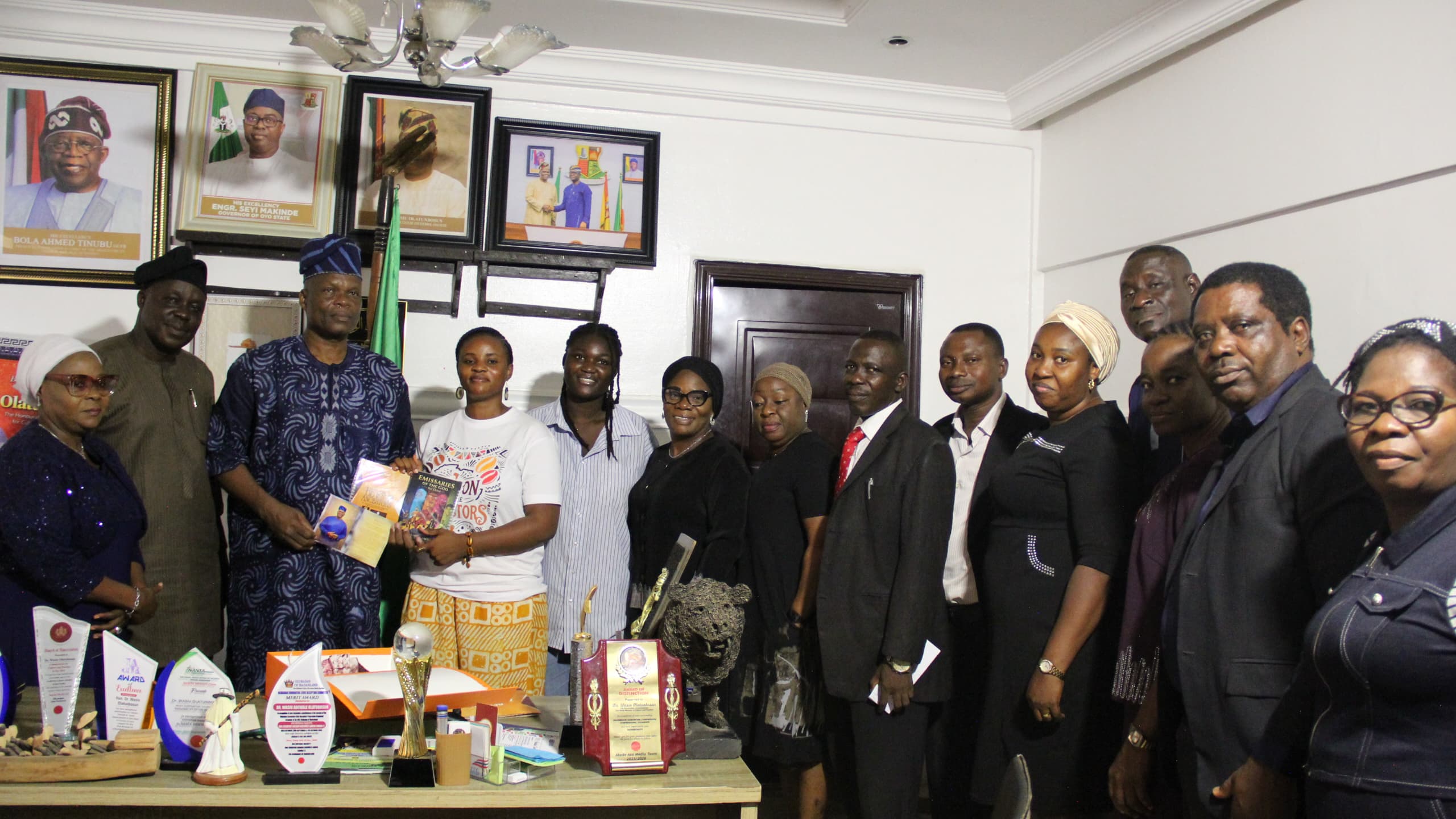
The Oyo State Government has expressed its readiness to support initiatives that promote Yoruba cultural heritage, particularly among the youth, as part of efforts to preserve the rich traditions of the state.
The Commissioner for Culture and Tourism, Dr. Wasiu Olatubosun, made this known while receiving the delegation of the Itansan Arts Festival team during a courtesy visit to his office in Ibadan.
Olatubosun commended the organisers for the initiative, describing the festival as a laudable effort aimed at celebrating and projecting the cultural heritage of the Yoruba people, particularly the ancestors who laid the foundation for the present generation.
He noted that the state government remains committed to encouraging programmes that will rekindle the interest of young people in culture and tradition, adding that cultural festivals play a significant role in preserving identity and promoting tourism.
The initiative, a newly established one, comprises young individuals committed to promoting Yoruba culture among youths through well-packaged cultural programmes that resonate with younger generations, many of whom have gradually distanced themselves from traditional cultural practices over the years.
Olatubosun commended the group for developing a robust programme aimed at promoting the cultural heritage of Oyo State.
He promised to support the initiative by providing an endorsement letter, attending the event, and offering assistance through the Ministry’s media unit to publicise the programme before, during, and after the event, as well as facilitating any other support needed through relevant agencies.
The Commissioner also advised the team to ensure proper planning and coordination in order to achieve a successful outing.
Speaking on the purpose of the visit, the Convener and Festival Director of the Itansan Arts Festival, Adewumi Adekunle, explained that the team came to seek endorsement and to officially inform the State Government about the maiden edition of the initiative designed to celebrate Yoruba culture, arts, and heritage in ways that resonate with young people.
She added that the festival would particularly highlight Yoruba ancestors.
“Over time, we observed that people are no longer talking about our ancestors, even though each of us shares one trait or another that can be traced to them as our progenitors. We want people to see and learn about our ancestors from a different perspective from what it used to be in the past,” she said.
Adekunle further disclosed that the event, scheduled to hold in May would feature an inter-school competition among secondary school students, where participants would speak on Yoruba deities or traditions.
According to her, presentations would take the form of visual arts, writing, and oratory, with entries judged accordingly.
Other highlights of the programme include a stage play titled “The Beacons of the Ancestors,” which aligns with the festival’s theme of portraying present generations as the light of their ancestors.
There will also be the launch of a book titled “Emissaries of the Gods,” which presents Yoruba ancestors as cultural heroes.
Members of the management team of the Oyo State Ministry of Culture and Tourism appreciated the initiative for identifying the Ministry as a platform to further project its vision and programmes.
They commended the team for complementing the efforts of the Oyo State Government in promoting culture and tourism while engaging young people as active stakeholders in cultural preservation.
They also expressed optimism that the programme would further strengthen awareness of Yoruba cultural heritage among the younger generation and prayed for the success of the forthcoming festival.
-

 news12 months ago
Interrogating the connection between social service and charity
-
news3 months ago
Arrive Early To Examination Centers, Comport Yourselves – Oyo HOS Admonishes Civil/Public Servants
-
news11 months ago
ANPP block in APC expresses deep concern over marginalisation to re-evaluate membership
-
news9 months ago
LG Commission Chairman ‘Wolekanle’ Gets Oyo NULGE’s Support
-

 news1 year ago
Abdulrazaq Inspects Govt’s Multistorey Prototype School
-
 economics1 year ago
NNPC Shipping, partners unveil joint venture to boost crude transport
-

 news1 year ago
Man arrested for beating girlfriend to death in Lagos
-

 economics1 year ago
Subscribers lament as MultiChoice raises DStv subscription by 21%