
news
Environmental Violations: Oyo Govt Seals Herbal Firm in Ibadan

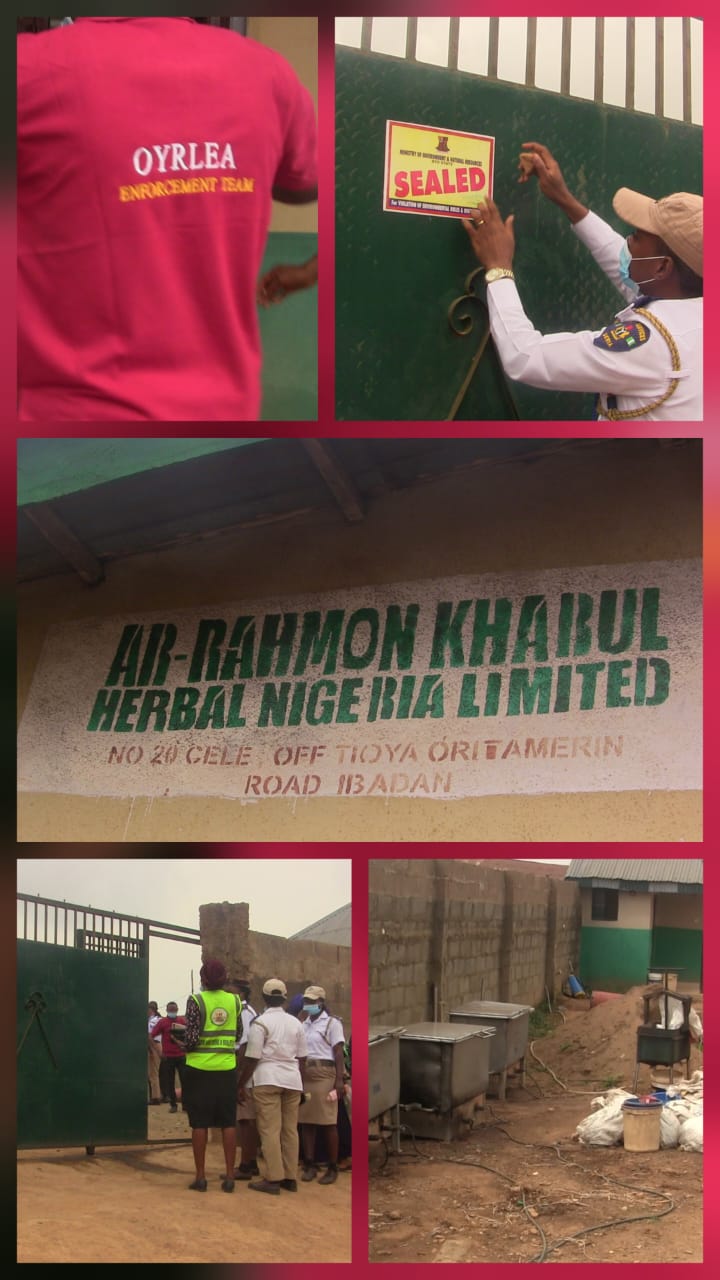
The Oyo State Government has sealed off Ar-Rahmon Khabul Herbal Nigeria Limited, located at 20 Cele, Off Tioya Orita-merin Road, Ibadan, over confirmed environmental violations and public health concerns.
The Chairperson of OYRLEA, Hon Justice Aderonke Aderemi (rtd), said on Friday that the enforcement action was carried out by officials of the Oyo State Rule of Law Enforcement Authority (OYRLEA), in collaboration with the Oyo State Ministry of Environment and Natural Resources.
According to her, the enforcement followed multiple petitions from residents alleging persistent offensive odour and health challenges linked to the company’s operations.
She said that “the action is necessary to protect public health, preserve environmental standards, and enforce regulatory compliance across the State.”
She added that, “joint inspections by officials revealed that the company operates a herbal production facility within a densely populated residential area, in clear violation of environmental and public health standards”.
Investigations further identified tobacco leaf as a major component in its production process, generating a strong, putrid odour deemed hazardous to residents and capable of posing serious health risks to the surrounding community.
Further findings from the inspection include the emission of harmful and toxic gaseous substances into the atmosphere, the discharge of wastewater into a nearby community water body, the installation of a chimney deemed too short and directly facing residential buildings, and the accumulation of solid waste within the premises despite claims of engaging a waste contractor, among others.
Prior to the enforcement action, the Authority had issued an abatement notice directing the company to cease operations and relocate within 21 days in accordance with the Oyo State Environmental, Sanitation and Waste Control Regulations.
OYRLEA, along with the agencies that carried out the enforcement, reiterates that air pollution, hazardous waste discharge, and improper waste management are violations of environmental laws.
She reaffirmed OYRLEA’s commitment to sustained monitoring and enforcement to ensure a safe and healthy environment for all residents.
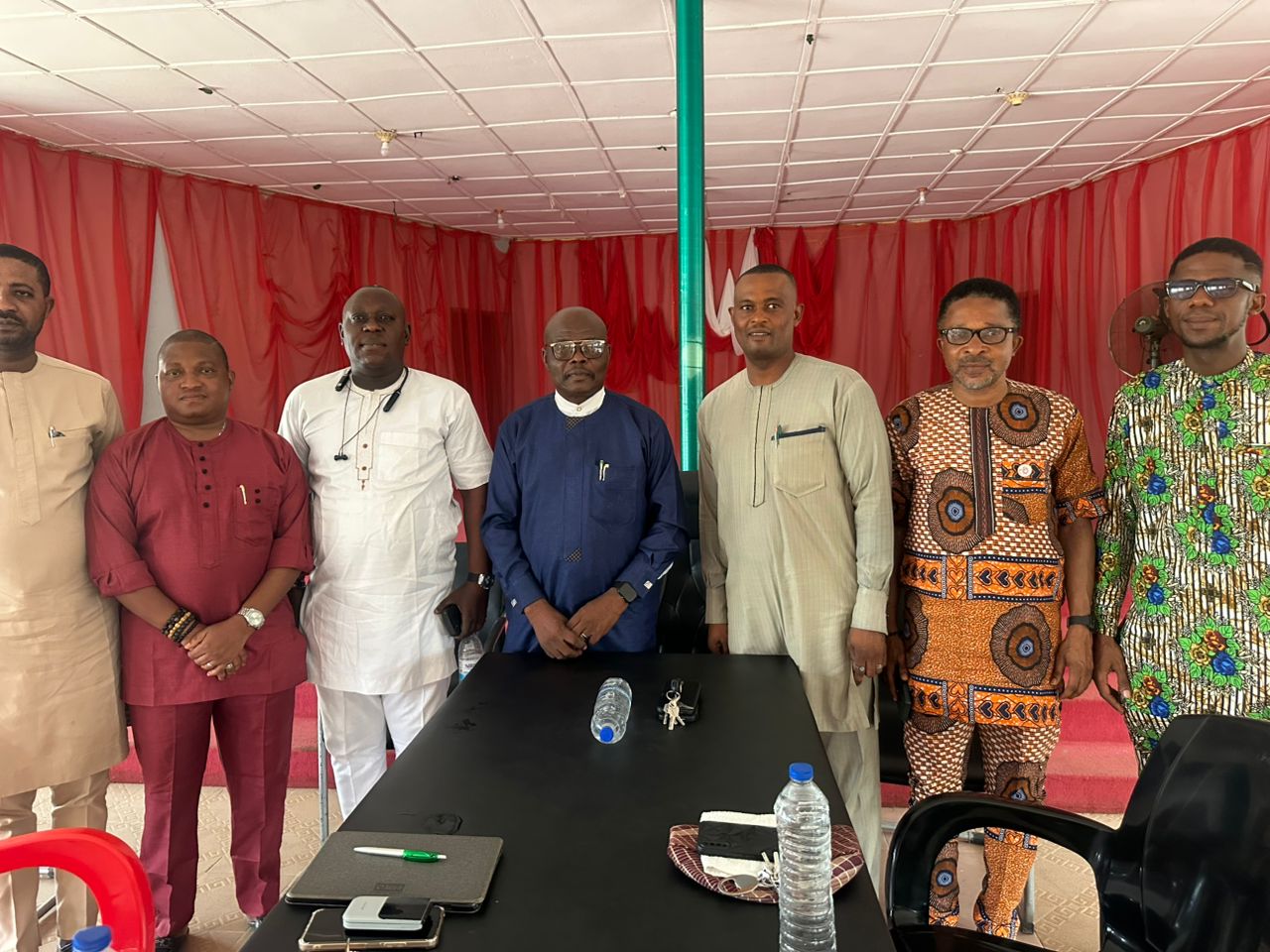
The Chairman of the Christian Association of Nigeria (CAN), Oyo State Chapter, Rev. Elisha Kayode Ogundiya, has admonished Christian journalists in the state to uphold truth, fairness and professional integrity in the discharge of their duties.
He made the remarks when the leadership of the Nigeria Association of Christian Journalists (NACJ), Oyo State Chapter, led by Comrade Lekan Sobo Sobowale, paid him a courtesy visit in his office alongside other members of the association.
A statement issued by the NACJ Public Relations Officer, Comrade Adeola Badru, quoted the CAN chairman as saying that journalists are critical stakeholders in nation-building whose reports shape public opinion and influence policy direction.
According to him, journalists must remain courageous, objective, and guided by ethical standards, especially when reporting issues that concern faith, governance and human rights.
Rev. Ogundiya noted that Christian journalists, in particular, have a dual responsibility to reflect the values of their faith while maintaining the highest standards of professional journalism.
He recalled his experience as CAN chairman in Osun State during the administration of Ogbeni Rauf Aregbesola, when the introduction of compulsory hijab wearing and a uniform dress code for all public schools generated widespread controversy and public outcry across the state.
The CAN chairman explained that the policy sparked debates over religious freedom and constitutional rights, prompting strong reactions from various stakeholders.
He extolled the role played by Christian journalists and members of the Nigerian Bar Association (NBA) during the period, noting that their intervention helped to amplify concerns and ensured that due process and the rule of law were followed.
“Christian journalists stood firm in defence of truth and fairness at a time when emotions were high. Their reports gave voice to the concerns of many citizens,” he said.
“We must never underestimate the power of responsible journalism in safeguarding democracy and protecting fundamental human rights.”
Ogundiya stressed that the media remained a vital instrument for promoting peaceful coexistence in a multi-religious society.
He, however, charged Christian journalists to always verify facts before publication, avoid sensationalism, and resist any attempt to compromise their professional ethics.
“You must be thorough, balanced and fearless. Do not allow bias or external pressure to distort the truth,” he said.
“Let your reports promote unity, justice and understanding, rather than division. When you stand for truth, you stand for God and for the nation,” he added.
Earlier in his remarks, the NACJ chairman in the state, Comrade Lekan Sobowale, congratulated Rev. Ogundiya on his emergence as CAN chairman in Oyo State and pledged the association’s support for the Christian body.
He commended CAN’s leadership for its commitment to defending the rights and interests of Christians, assuring that NACJ members would continue to uphold professionalism in their reportage.
Sobowale called for renewed synergy between the association and CAN, adding that closer collaboration would strengthen advocacy efforts and enhance effective communication within the Christian community.
“We believe that a strong partnership between CAN and NACJ will foster better information dissemination and ensure that the voice of the Church is accurately represented in the public space,” he said.
In her vote of thanks, the Treasurer of NACJ, Comrade Mosun Akinola, appreciated the CAN chairman for receiving the delegation and for his words of encouragement.
She reaffirmed the association’s commitment to responsible journalism and pledged continued cooperation with CAN in advancing shared values and promoting peaceful coexistence in the state.
news
*President on Solar, People in Darkness: Renewable Progress or National Paradox? – By Lanre Ogundipe*
Let us begin with numbers — because numbers do not shout, they reveal.
₦17 billion allocated for a solar microgrid at Aso Rock Presidential Villa. Full disconnection from the national grid by March 2026.
Testing underway since December 2025. ₦47 billion annually reportedly spent on electricity at the Villa.
These figures demand not outrage, but interrogation.Globally, renewable energy transition is no longer optional — it is strategic. The United States has committed hundreds of billions of dollars under green transition policies.
China dominates global solar manufacturing. Europe has accelerated solar and wind adoption in response to energy insecurity. Across Africa, countries are repositioning.
South Africa has expanded embedded generation policies to ease pressure on Eskom. Kenya generates over 80% of its electricity from renewables, primarily geothermal and hydro.
Morocco has invested heavily in large-scale solar complexes like Noor Ouarzazate. Egypt is expanding Benban Solar Park. Rwanda is scaling mini-grids for rural electrification.
Renewable energy is the direction of the future. Nigeria should not lag behind.
But here is the paradox: while the Presidency embraces renewable autonomy, the national grid remains fragile. Nigeria continues to experience recurring grid collapses.
Manufacturing output has struggled amid energy instability. According to industry bodies, manufacturers spend a substantial portion of operational costs on self-generated electricity — often powered by diesel.
Some sectors report energy accounting for 30–40% of total production cost.
Factories scale down. SMEs shut doors. Investors calculate risk premiums. The cost of doing business rises. Electricity is not merely a utility; it is economic oxygen.
Now consider this contrast: The Presidency is preparing to permanently disengage from the grid because it is unreliable and expensive.
If the national grid cannot reliably power Aso Rock, what confidence should industry have?
The reported ₦47 billion annual electricity bill at the Villa raises urgent questions.
Even accounting for diesel backup systems and high-capacity demand, that figure is staggering.
Nigerians deserve transparency on what drives that cost structure.
If a ₦17 billion solar investment can substantially reduce or eliminate a ₦47 billion recurring expense, then the economic logic is compelling.
The payback period appears short. The savings potentially significant.
But then comes the unavoidable question: Why has similar urgency not been applied to federal hospitals? To public universities? To industrial parks? To research institutions?
If decentralized renewable systems are economically rational for Aso Rock, they are equally rational for federal teaching hospitals battling power interruptions during surgeries.
They are rational for industrial clusters struggling under diesel burden. They are rational for rural electrification.
Renewable energy should not be symbolic. It should be systemic. Nigeria’s manufacturing sector has faced contraction pressures. Rising energy costs compound inflationary stress.
The Manufacturers Association of Nigeria has repeatedly cited power instability as a primary constraint on productivity.
When industries collapse or scale down, unemployment rises. When unemployment rises, purchasing power shrinks. When purchasing power shrinks, economic growth weakens.Energy instability cascades.
Against this backdrop, the solar transition at the Presidency risks appearing insulated rather than integrated.
Let us be clear: there is nothing wrong with securing stable power at Aso Rock. National security demands redundancy. Diesel dependency is inefficient and costly. Solar adoption is modern governance.
The issue is not adoption. It is distribution.The government’s “Renewed Hope” mantra rests on structural transformation. But hope must be experienced in tangible infrastructure.
Hope must be measurable in megawatts delivered nationwide.
Hope must be reflected in reduced collapse frequency. Hope must be visible in factories operating without interruption.
If renewable transition is the strategy, publish the roadmap.What is the megawatt target for federal institutions?What is the timeline for grid modernization?
What proportion of federal capital expenditure is earmarked for decentralized renewables beyond Aso Rock? Global renewable advancement is not selective. It is layered and inclusive.
Governments move executive buildings, yes — but they simultaneously roll out nationwide frameworks.Without that broader architecture, perception hardens. And perception matters.
When citizens paying higher Band A tariffs sit in darkness while the Presidency secures uninterrupted supply, the narrative writes itself.
Energy inequality widens when those with capital escape grid fragility while the majority remain captive to it. Policy should narrow that divide.
There is also the matter of reform urgency. Shared vulnerability accelerates reform. When leaders experience systemic fragility alongside citizens, repair becomes imperative.
When insulation sets in, momentum can slow.Nigeria’s power sector has undergone privatization, recapitalization, tariff reform, and restructuring over the past decade. Citizens have borne the financial consequences.
Now they witness executive disengagement. The Federal Government faces a defining choice. It can allow this solar transition to stand as an isolated executive solution. Or it can frame it as Phase One of a nationwide renewable transformation anchored in transparency, scalability, and accountability.
The latter strengthens confidence. The former deepens skepticism.Nigeria should be leading West Africa in renewable deployment.
With abundant sunlight, vast land, and energy demand, the country possesses enormous potential. Solar mini-grids could power rural communities. Industrial solar clusters could stabilize production.
Public infrastructure could transition gradually but decisively. But reform must not appear concentrated at the top.
The ₦17 billion solar investment at Aso Rock will be judged not by its panels, but by its precedent.
Does it signal systemic transformation — or selective illumination?Renewed Hope cannot become an albatross weighed down by visible asymmetry.
Hope must circulate. Electricity must circulate. Because a nation is not powered by one compound. It is powered by shared systems. And leadership is not measured by how brightly the Presidency shines. It is measured by whether the republic shines with it.
LanreOgundipe, Public Affairs Analyst, former President Nigeria and Africa Union of Journalists writes from Abuja February 20, 2026.

The Olubadan of Ibadanland, Oba Rashidi Adewolu Ladoja has hailed Chief Mrs Titilope Akande, wife of the late Ibadan-born multi-billionaire businessman, Chief Harry Ayoade Akande for empowering the needy.
The Chairman, Oyo State Council of Obas and Chiefs gave the commendation when Chief Mrs Akande led members of her Foundation on a courtesy visit to his Bodija, Ibadan residence.
Oba Ladoja, who recalled with nostalgia his previous association with the late Agbaoye of Ibadan, commended Chief Mrs Akande for finding space in her heart to bless the underpriviledged in our society, rather than staying in her comfort zone abroad.
This, the monarch contended, reflects her love for humanity and generosity of her spirit. Said Olubadan: “Of particular note is your ability to trudge on despite the unfortunate loss of my beloved brother and my senior at Olivet Baptist High School, Oyo who graduated a year ahead of me. It is my prayer that God will continue to comfort you and the family.”
Earlier, Chief Mrs Akande said the Foundation became imperative because human beings are not created equal, saying the strength of her Foundation is need assessment.
She commended the Foundation members for their sacrifices , integrity and honesty of purpose.
news
*EKITI STATE EXECUTIVE COUNCIL APPROVES TOURISM POLICY AND DEVELOPMENT MASTER PLAN* …Oyebanji Breaks Tourism Jinx, Produces Nigeria’s First Sequential Tourism Governance Framework

A defining and historic milestone has been recorded in the annals of tourism development in Nigeria as the Ekiti State Executive Council (EXCO) formally approved the implementation of the Ekiti State Tourism Policy alongside the Ekiti State Tourism Development Master Plan (2025–2035).
This landmark approval signals a new strategic dawn in the transformation of Ekiti State’s tourism corridor and firmly positions the State on the path to becoming a premier heritage and nature-based tourism destination in Nigeria, West Africa, and the global tourism marketplace.
With this singular achievement, His Excellency, Governor Biodun Abayomi Oyebanji, has broken what industry observers describe as Nigeria’s longstanding “tourism governance jinx” by emerging as the first State Governor in the history of tourism development in Nigeria to initiate, produce, and secure Executive approval for the two most fundamental tourism development instruments — a Tourism Policy and a Tourism Development Master Plan — in a deliberate and sequential order.
This dual-document governance architecture provides, for the first time, a structured institutional compass and an execution blueprint for tourism growth not only in Ekiti State but as a reference model for sub-national tourism planning across Nigeria.
Even more historically significant is the global institutional collaboration that underpinned the policy framework. For the first time in the history of the United Nations Tourism system, the global body directly collaborated with a sub-national government in the conceptualisation and development of a Tourism Policy — the Ekiti State Tourism Policy.
The organisation deployed its officials to provide technical guidance, international benchmarking, and professional advisory support, thereby conferring global credibility and international currency on the document.
The Tourism Development Master Plan (2025–2035), approved for implementation by EXCO, is designed as a long-term strategic roadmap to unlock Ekiti State’s vast but previously under-optimised tourism assets.
It provides a comprehensive, practical, and sustainable framework to transform the State into a leading tourism hub through phased infrastructure development, investment mobilisation, thematic tourism circuits, and enhanced visitor experience systems.
The Plan aligns with international standards and reflects collaboration with global institutions while placing strong emphasis on job creation, local enterprise stimulation, cultural preservation, environmental sustainability, and inclusive economic growth for host communities.
Developed under the coordination of the Ekiti State Bureau of Tourism Development, the Master Plan leverages Ekiti’s rich endowments — including waterfalls, warm springs, mountains, cultural heritage corridors, historical relics, and eco-tourism landscapes — to enhance the State’s competitive positioning as a destination of choice.
To ensure technical depth and global best practice, Red Clay Advisory Services, a reputable tourism planning and advisory firm, was engaged to prepare the Master Plan and deliver a forward-looking blueprint tailored to Ekiti’s unique tourism identity and development aspirations.
Complementing the Master Plan is the Tourism Policy Document — a strategic governance framework designed to guide implementation, regulation, investment promotion, institutional coordination, and sustainable tourism growth.
The Policy Document, also driven by the Bureau of Tourism Development, establishes the philosophical foundation upon which the Master Plan operates. It promotes eco-tourism, cultural tourism, adventure tourism, and business tourism while outlining mechanisms for infrastructure enhancement, safety standards, service excellence, and niche market development.
Overseas Credit & Private Equity Limited was engaged to develop the Policy framework, bringing its expertise in tourism planning and advisory services to bear in crafting a globally compliant policy structure.
Together, the Tourism Policy serves as the compass, providing direction, governance structure, and regulatory clarity, while the Tourism Development Master Plan stands as the execution engine, translating vision into projects, investments, infrastructure, and measurable socio-economic outcomes.
Speaking on the historic approval, the Director-General of the Ekiti State Bureau of Tourism Development, Barrister Wale Ojo-Lanre, Esq., described the moment as:
“A structural rebirth of tourism governance not only in Ekiti State but a reference point for sub-national tourism development across Nigeria. This approval moves tourism from aspiration to execution.”
He noted that the next phase would focus on implementation activation, stakeholder mobilisation, investment attraction, and institutional delivery mechanisms.
The ultimate goal of the twin documents is to unlock Ekiti State’s vast tourism potential, generate sustainable employment, stimulate small and medium enterprises, attract domestic and international visitors, and deliver shared prosperity to residents and investors alike.
With this approval, Ekiti State sets its sights on attaining global recognition as a leading eco-cultural tourism destination.
Further announcements on policy unveiling, investment summits, and implementation milestones will be communicated in due course.

The Defence Attachés of the United Kingdom and Germany to Nigeria, Brigadier Tom Harper and Colonel Boris Bovecamp, have reaffirmed continued support and collaboration in the fight against terrorism and insurgency.
This assurance was during their visit to the Headquarters of the Theatre Command, Operation HADIN KAI (OPHK), in Maiduguri.
A statement by the Media Information Officer, Headquarters Joint Task Force Operation HADIN KAI, Lieutenant Colonel Sani Uba indicates that Brigadier Tom Harper commended the Nigerian Armed Forces’ efforts in tackling terrorism in the North East region, particularly through Operation HADIN KAI, and expressed the UK’s commitment to providing further training support through the British Military Advisory Team (BMATT).
Equally, the Defence Attaché of Germany to Nigeria, Colonel Boris Bovecamp said he was in the Theatre to explore possible areas of future collaboration especially in the area of capacity building as well as possible interventions through regional cooperation arrangements to enhance operational effectiveness and collaboration to defeat terrorism.
The Theatre Commander of OPHK, Major General Abdulsalam Abubakar, lauded the significant contributions of the UK and German Defence Attachés to counter-insurgency efforts, noting that training initiatives have enhanced troops’ skills and proficiency in responding to evolving security challenges in OPHK emphasizing the mutual benefit of the partnerships.
He highlighted areas of future collaboration to include technical expertise as well as equipment and logistics support.

The Nigeria Union of Journalists (NUJ), Oyo State Council, has expressed deep sorrow over the death of Deputy Editor, Nigerian Tribune, Oladipo Ogunsola, popularly known and called “Prince D”, who passed away on Wednesday, February 18.
In a statement jointly signed by the Chairman, Akeem Abas and Secretary, Temidayo Adu and made available to newsmen on Thursday in Ibadan, the council described late Oladipo Ogunsola as a cool, calm, intelligent, amiable, peaceful and resourceful journalist whose dedication to journalism and service to humanity stood him out.
The NUJ noted that his commitment to ethical reporting, professionalism and comradeship earned him respect across newsrooms and within the union, adding that his death was a painful loss to the media family.
It prayed that Almighty God will look kindly upon His servant, Oladipo Ogunsola, grant him merciful judgement, forgive his shortcomings and grant him eternal rest in His bosom.
The council commiserated with his immediate family, management and staff of the Nigerian Tribune, friends and professional associates, urging them to take solace in his impactful life and enduring legacy.
-

 news11 months ago
Interrogating the connection between social service and charity
-
news2 months ago
Arrive Early To Examination Centers, Comport Yourselves – Oyo HOS Admonishes Civil/Public Servants
-
news10 months ago
ANPP block in APC expresses deep concern over marginalisation to re-evaluate membership
-
news8 months ago
LG Commission Chairman ‘Wolekanle’ Gets Oyo NULGE’s Support
-
 economics12 months ago
NNPC Shipping, partners unveil joint venture to boost crude transport
-
 news12 months ago
Abdulrazaq Inspects Govt’s Multistorey Prototype School
-

 news12 months ago
Man arrested for beating girlfriend to death in Lagos
-

 economics12 months ago
Subscribers lament as MultiChoice raises DStv subscription by 21%