
news
OYLGSPB Management, Staff Felicitate With Its Chairman, Akeem Demola Ige On His Birthday


The management and staff of the Oyo State Local Government Staff Pension Board have congratulated the Chairman of the Board Hon Akeem Ademola Ige on his 58th birthday celebration.
The staff congratulated their boss in a release issued and made available to journalists .
Speaking at a surprise birthday held at the celebrant’s residence early this morning, the Acting Head of Local Government Administration of the Board, Alhaji Musibau Olatunbosun Ladele said ” today , we celebrate a rare leader and extra ordinary man. You have been a benefactor to many within and beyond government, across religious and political circles. On behalf of the management and staff of the Oyo State Local Government Staff Pension Board, we join your family, friends , associates ,admirers, mentees to sincerely felicitate our amiable, indefatigable, compassionate Chairman, Hon Akeem Ademola Ige on your 58th birthday celebration today, Sunday, 15th February, 2026.”
” You are a great leader, role model, mentor , and kind-hearted boss to all of us and we want to use this auspicious occasion of your birthday to let you know that we love you from the bottom of our hearts and pledge our continued support and cooperation to you for the smooth running of administration of the Board under your watch.”
“We also pray that Almighty Allah will grant you long life, more fruitful years in sound health and prosperity. Do have a fantastic and joyous day Sir.
In their separate goodwill messages, the Director of Finance and Supplies , Mrs Temiyayo Adeyemo spoke on behalf of all the Directors and NULGE Chairman of the Board Comrade Ademola Adedokun congratulated Hon Akeem Ademola Ige on his birthday and prayed that God will grant him long life in sound health.
In his response, the celebrant, Hon Ige appreciated the management and staff of the Board for the love , gifts and most especially the surprise birthday celebration held at his residence.

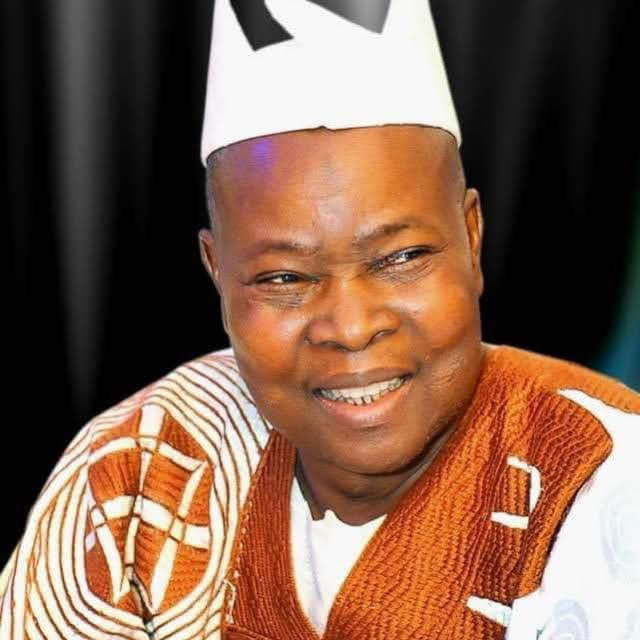
*Many people would not remember that Aare AbdulAzeez Arisekola-Alao would have been 81 years old today. I celebrate the posthumous 81st birthday of Aare AbdulAzeez Arisekola-Àlao, a dignified son of Ibadanland, Yorubaland and a beacon of excellence. His indelible mark on Nigeria’s socio-political landscape continues to inspire.*
As a prominent businessman and Islamic leader, Arisekola-Àlao championed economic empowerment, uplifting countless lives through his generosity and kindness. He proudly promoted Yoruba heritage, fostering unity and pride.
His legacy continues to inspire: a dedication to community development, a benchmark for leaders in community service and an unparalleled impact on Yoruba culture and identity.
As we reflect on his legacy: his contributions to Nigeria’s growth and development are undeniable; his commitment to community service sets a benchmark for leaders; and his impact on Yoruba culture and identity remains unparalleled
On this day, I celebrate your life, achievements and enduring influence. May Allah grant you Aljannah Firdaus.
As we cope with the challenges of our time, Arisekola-Àlao’s example reminds us that greatness is measured by impact, not just title. Rest in peace, Aare AbdulAzeez Akanmu Arisekola; your legacy lives on, Sir!
Tunji Oladejo, mnipr, JP, writes from the University of Ibadan and is the Chairman of The Progressive Forum, Ibadan (TPFI) via oladejo65@gmail.com. 08077284442
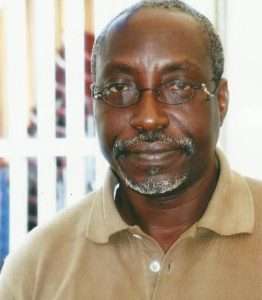
When a former governor publicly alleges that he learned of an impending arrest because the National Security Adviser’s phone call was “tapped,” the matter ceases to be personal. It becomes constitutional.
In a televised interview on Arise TV, Nasir El-Rufai suggested that he became aware of official moves against him through intercepted communications allegedly linked to the office of the National Security Adviser.
The statement was delivered almost casually, as if surveillance at the highest level of national security were an ordinary feature of political life.
It is not.If taken seriously, the implications cut to the heart of the republic.Surveillance Is an Exceptional Power – under Nigeria’s constitutional order and relevant telecommunications and cybercrime laws, interception of private communication is not a political instrument.
It is an extraordinary power, reserved for narrowly defined circumstances and subject to legal authorization.
Surveillance requires lawful approval. It must be tied to national security threats or serious criminal investigation.
Judicial oversight is not decorative; it is foundational.
If the National Security Adviser’s communication was intercepted, immediate questions arise: Was there judicial authorization? On what legal suspicion was the interception predicated?Which agency executed it?Was the NSA himself under lawful scrutiny? If lawful, then the public deserves structured clarification about the scope and boundaries of such authority. If unlawful, the breach is grave.
Unauthorized interception violates constitutional privacy protections and potentially attracts criminal liability.
Either possibility unsettles institutional confidence.Access Is Also a Legal Question The constitutional concern does not end with the interceptor.
It extends to the recipient of the intercepted intelligence.Under established legal principles, unauthorized possession, dissemination, or use of classified or illegally obtained communication may itself constitute an offense.
The law scrutinizes not only the act of interception, but the chain of custody and benefit.
When a prominent citizen publicly implies access to tapped communications, it invites inquiry: Who provided the information?Was it classified? Was its acquisition lawful? Was there collusion or breach of protocol?The audacity is not merely in alleging surveillance; it is in invoking access to its product.
If the claim is rhetorical flourish, it weakens institutional credibility. If literal, it raises serious legal exposure. In either case, democratic confidence is strained.
Perhaps the most disturbing element is normalization.When exceptional surveillance powers are referenced casually, their gravity diminishes. Intelligence interception exists to protect national security — not to become currency in elite rivalry.
Nigeria’s security architecture has long contended with overlapping mandates and contested transparency.
Oversight mechanisms exist, but public trust in their robustness remains uneven.Public assertions of intercepted communications deepen that distrust.
Yet institutional imperfection does not excuse individual responsibility. No citizen, however influential, stands beyond the reach of legal scrutiny. If the claim is true, it reveals potential vulnerability within intelligence discipline.
If exaggerated, it erodes institutional credibility.Both outcomes are injurious.
The rule of law is not selective.If unlawful interception occurred, it must be investigated. If classified intelligence circulated improperly, it must be examined.If the allegation lacks evidentiary basis, reputational consequences must follow.
Exceptional powers must remain exceptional — constrained by law, supervised by oversight, insulated from factional deployment.
A republic governed by law cannot function through whispered intercepts and informal access to state intelligence.Boundaries must hold.
Postscript: When the State Falls Silent Abroad: If the surveillance episode raises concerns about the boundaries of state power at home, unfolding events abroad raise equally serious questions about state responsibility.
Nigerian names have appeared in casualty disclosures connected to the Russia–Ukraine war. Hamzat Kazeen Kolawole. Mbah Stephen Udoka. Reportedly killed in November 2025 while attached to a Russian military unit.
Before these confirmations, another Nigerian, widely reported as Abubakar Adamu — surfaced in a distress video, appealing in Hausa for rescue and repatriation after allegedly discovering that his overseas “employment” had led into military entanglement.
This is no longer conjecture. It is loss.How are Nigerian citizens entering foreign military formations?Were the contracts fully understood? Were recruitment channels transparent? Were intermediaries operating within Nigeria?If citizens knowingly enlisted, clarity must be provided.
But if recruitment occurred through deception, misrepresentation, or exploitation of economic vulnerability, then the issue transcends migration. It becomes a security concern.
Economic strain at home makes risk seductive.
Youth unemployment and inflation sharpen vulnerability. But vulnerability must not become a pipeline to foreign battlefields.If recruitment networks are operating within Nigeria; formal or informal — they must be investigated.
If regulatory loopholes are being exploited, they must be closed. If citizens are being misled, prosecution must follow.
Diplomatic engagement must also be firm. The Ministry of Foreign Affairs should seek structured clarification regarding recruitment and deployment of Nigerian nationals.
Reports suggest that other African nationals have also appeared among casualties in the same conflict.
If recruitment patterns extend across borders, the African Union must treat this as urgent. Intelligence coordination and preventive advisories are essential.
Africa must not become expendable manpower in external rivalries.
The surveillance controversy and the foreign war casualties appear separate. They are not.
The boundary between intelligence power and political rivalry. The boundary between opportunity and exploitation.
The boundary between rhetoric and criminal implication.The boundary between sovereignty and vulnerability.
A republic survives when those boundaries are respected. When exceptional powers become normalized, when intelligence becomes theatre, when citizens drift into foreign wars through opaque channels, the state must respond, not selectively, not theatrically, but consistently.
The rule of law at home. Protection of citizens abroad.That is the standard. A nation is measured not only by the authority it wields and by the boundaries it enforces.
Lanre Ogundipe, Public Affairs Analyst and former President, Nigeria and Africa Union of Journalists, writes from Abuja.February 14, 2026.
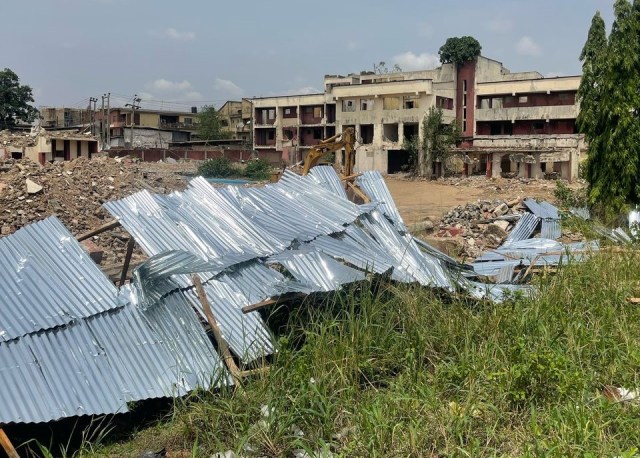
At the height of its glory, D’Rovans Hotel in Ibadan, Oyo State, stood like the Chappal Waddi. Standing 2419 meters or 7996 feet above sea level, this mountain, infamously nicknamed the Mountain of Death, near the Cameroon border, in Taraba State, is said to be the highest in West Africa. D’Rovans shares that colossal legend. In top-tier hospitality and as a hub of entertainment and luxury, its fame rose tremendously in the 80s and 90s.
The zenith of its glory however came on January 26 and 27, 1999. As the political history of 4th Republic Nigeria was getting ready to be incubated, fate, in its elegant cursive, wrote D’Rovans into its script. Mindful of the historical role of Ibadan as the city where Immortal Obafemi Awolowo curated those eponymic developments of the First Republic, the feet of the egg-heads of politics, the Aworosasa of the Alliance for Democracy (AD) gathered in Ibadan. By midnight of January 27, the Southwest would lose its deposit, having been unanimously favoured to preside over Nigeria by the exiting military big-epaulettes, if the AD failed to submit the name of its presidential candidate to INEC.
Twenty three electors gathered in D’Rovans. I was there all through the night as a reporter. The electoral college comprised the ‘wise men’ who would determine the fates of Arole Awolowo, Chief Bola Ige and his rival, Chief Olu Falae. The aftermath of the decision to choose Falae and vote out Ige, as significant as it was for D’Rovans, also made the hotel the locus inquo, the place where the seed of the discord in Southwest politics was sown. Thus, it is impossible to write the history of the factionalization of Western Nigeria politics in this Republic, the rancour that subsists therein even till today, without a mention of D’Rovans. Afterall, my people say it is impossible to collate the process of turning the head of a dog into a delectable cuisine without mentioning the pot with which it was cooked.
Recently, viral videos, anchored by bloggers, have feasted on the ruins that D’Rovans has turned into. In the bloggers’ narrative, today, the majestic D’Rovans has caved in. Transiting from its franchise name, at a time, D’Rovans became known as Wallan Hotel. As the hive is home to bees, the deep sea the domicile of sharks, and the lair is palace of wild animals, this hotel was also haven for the rich and famous. Lodging at D’Rovans was an emblem of high society. It was out of example for any guest of note to the headquarters of southwest Nigeria to hibernate anywhere other than D’Rovans. It had panache, fame and majestic aura that stood it out, relative to its time. Brainchild of Edo-State born former Nigerian boxer, businessman and engineer, Francis Aiyegbeni, by the time of Aiyegbeni’s passage in 2016, D’Rovans was under the receivership of AMCON, which sold the hotel, purportedly for N340m, to offset debt owed a bank. Its recent owner has just brought boulders into its premises, reducing a once magnificent hospitality haven into rubbles and dusts.
The bloggers also laced their narratives on the grandeur and death of D’Rovans with nuggets about the hopelessness and vanity of life. In the process, they attempted to make a synedoche of the hotel’s mutation from glory to ruins. A literary device, synedoche uses the small part of a thing to represent the whole, or vice versa. The video interrogates the question, can an object like the hotel summarize life in its entirety? Put differently, can a small life occurrence approximate whole existence? Can the transmutation from glory to ruins, life to death of D’Rovans represent the life we live?
Talking about a part representing a whole, I am reminded of the life of Zimbabwean novelist, playwright, poet and short story writer, Dambudzo Marechera. His magnum opus book, The House of Hunger, is considered a huge chip off his distorted life. The preachings in Marechera’s is almost synonymous with late reggae music great, Jimmy Cliff’s House of Exile. In it, James Chambers (his real name) attempted to philosophize the vanity of life. He sang, “There’s a day of feasting and a day of famine/Day of sadness and a day of joy/You could see in the day of feasting/Life isn’t just a little play-like toy/So your day arrived when you least expected/’Cause you always thought you were well protected/Now you feel like a fish out of water/So now you’re wondering what’s the matter/Oh remember you said it wouldn’t happen to you
last mile/…Everything in creation must obey a law/It’s true in words as it is in deed”.
Dambudzo was child of Shona ethnic nationality parents. His father was a mortuary attendant and mother, a maid. The violence, racial discrimination, his personal struggles with poverty, displacement, and mental health issues of colonial Rhodesia took a toll on his mentality. As he wrote about a body and spirit exiled from the land and the self in this iconic book, Dambudzo draws heavily on his personal history which was interpreted through the protagonist’s voice and the themes in the book.
Like the protagonist in the The House of Hunger, Dambudzo also lived an aimlessly wandering life defined by madness and brutality. As a pupil in Penhalonga, he was renowned for being very dirty and violent, always clashing with his teachers. Expelled from the University of Rhodesia, now Zimbabwe, at the New College, Oxford where he began his student life all over, he also faced expulsion for his violence, academic dereliction and unsociable behaviour. Indeed, The House of Hunger was a metaphor for the tumult of his upbringing and life in general. The book won the 1979 Guardian Fiction Prize and Marechera became the first and only African to win it in its 33 years. He instantly earned celebrity status in the English literary circle. This was however eclipsed by his recourse to constant outrage. For instance, while the buffet dinner for the Prize award was ongoing, Dambudzo, unprovoked, relapsed into a tantrum, flinging dining plates at a chandelier.
In Oxford, Dambudzo’s erratic behaviour was diagnosed as schizophrenia. On many occasions, he threatened to murder some people and set Oxford university on fire. He lived a troubled life and was in 1977 sent to the Cardiff prison for possessing marijuana. He later returned to his native Zimbabwe in 1982, to live a homeless life. He died in Harare in 1987 from an AIDS-related pneumonia at age 35.
As Dambudzo’s The House of Hunger was a picture of the totality of the dirty life and vagabond existence of its author, in what way does D’Rovans pose a lesson of life or picture of the life of perishable man? If we look at the transmutation of the hotel to what it is now, can we look at it with the lens of an elder’s eyes? Can D’Rovans pass for the Àgídìgbo, a traditional drum of Yoruba origin? The Àgídìgbo is a large, thumb piano box famously associated with Apala music genre. Though subtle in rhythm, Àgídìgbo’s drumbeat is proverbial. From it exudes words of wisdom. As it oozes metaphor and ancient sayings of our forefathers, like a speech surrogate, it conveys messages beyond just rhythm. It must be why it is said that the rhythm of Àgídìgbo comes in proverbial melodies. Only the wise (ológbón) can wag their buttocks to its melody and anyone but the discerning (òmò’ràn) can truly penetrate its cryptic message.
Let us try to use D’Rovans to explain the futility of human goals, the transience of the project of living, and the vanity of this world. Can it also be used to explain despair? The philosophy of despair asks questions like, what is the ultimate goal of life? Is life a futile, meaningless venture, an undertaking without any positive good or worth? If this is so, why then do we come to this world? If we were not privy to the process of being here, can’t we be privy to the process of exiting it midstream? In other words, is suicide justified?
Existential philosophers are at the fore of this enquiry into the life of vanity and the purpose of life. They agree that life is actually devoid of any inherent meaning or purpose. This submission on the vanity of life, they say, often pushes man to a feeling of absurdity or futility. One of its leading advocates, Algerian philosopher, Albert Camus, argues that we can however make meaning out of life by living it fully and creatively, thereby making its meaninglessness meaningful. However, rather than allow despair define life, existentialists canvass that we should get life’s meaninglessness to push us to embrace absolute freedom, create our own subjective values and define our existence the way we want it. To existentialists, suicide is cowardice and forbidden.
By using the illustration of the Myth of Sisyphus, of a man who pushes the boulder from the foot of a hill upwards and downwards daily, Camus indicates that we can create our escape route from the meaninglessness of this universe. This is also called existential nihilism. It is almost of the same persuasion with futilism, which also holds that life is ultimately meaningless. Sartre, the foremost existentialist, says this in his Being and Nothingness where he wrote that, “Man is a useless passion”. While a futilist says life is meaningless, Sartrean existentialists believe that our life is absurd. We must thus recognize this grim fact of the absurdity of our lives.
One missing screw that the Creator left on the lever of life is that joy is not absolute for humanity. Hardly can any man be joyful from morning till evening. In the midst of this, pain and pleasure define our lives. Hedonists say that the pursuit of pleasure over pain is the most desirable, but utilitarians say, getting either of the two – pleasure or pain – is a reward or punishment for our actions.
Life and death, growth and withering are two inseparable parts of human life. I remember my Editor on the Tribune’s Political Desk, Bisi Abidoye, over two decades ago, once retorted that, without those vanities, life would not be life. It is what D’Rovans signifies. No creation can avoid the vanities of life. It should then ordinarily teach man to live right since no one will leave life alive. Realizing the futility of existence and all human endowments and acquisitions, we should rather define the confines and boundaries of a good life that we want to live. No one can define it for you. How can we live a good and ethical life? Danish philosopher, Soren Kiekergaard, said that a life lived to serve others, one devoted to universal moral principles, is a life well lived. He asked that all human actions should be geared towards the common good and prioritising the betterment of the whole over the self.
In his The House of Hunger, Marechera emphasized the emptiness and despair that define existence. “Life,” he wrote, “stretched out like a series of hunger-scoured hovels stretching endlessly towards the horizon.” In another, he wrote, “The lives of small men are like spiders’ webs; they are studded with minute skeletons of greatness.”
All these suggest that the life lived for acquisition sake is an empty life. It is why, when you see Nigerian politicians enveloped in an orgy of acquisition, what you see is sickness of the mind. Delineate the boundary of when enough is enough in this empty life. When you do this, by the time you wither and pine away like the magnificent edifice of D’Rovans, you would rest happy that you lived a good life.

The Oyo State Police Command has intercepted two suspects over the alleged theft of diesel valued at about ₦12 million at a construction site in Ibadan, marking what the authorities described as a significant operational breakthrough.
Oyo state Police Public Relation Officer, DSP Ayanlade Olayinka, disclosed this in a statement on Friday evening.
The suspects according to the police, were apprehended by operatives of the Command Monitoring Unit at Kopek Construction Company in Ibadan while allegedly siphoning liquid substances believed to be diesel from a mixer truck.
According to the statement, the arrest followed credible intelligence and timely information provided by members of the public.
The police added that a search conducted at the scene led to the recovery of 24 barrels containing 240 litres each of liquid suspected to be diesel, amounting to approximately 10,000 litres.
Police authorities estimated the value of the recovered product at ₦12 million.
The Commissioner of Police in the state, CP Femi Haruna, commended the professionalism and dedication of the operatives involved in the operation.
He also lauded the leadership of the Inspector-General of Police, Kayode Adeolu Egbetokun, noting that his vision and guidance continue to strengthen policing efforts nationwide.
The Command further acknowledged the support of residents whose vigilance and cooperation aided the swift interception of the suspects and the recovery of the product, thereby preventing further losses.
The state Police command confirmed that the suspects are currently in custody, while investigations are still ongoing to determine the full extent of the alleged theft and identify any other accomplices.
Reaffirming its commitment to safeguarding lives and property, the Command urged members of the public to continue providing actionable intelligence to security agencies in the fight against crime
news
When the Iroko Answers the Ancestors: A Dirge for BJ The drum has spoken in a minor key – Lanre Ogundipe
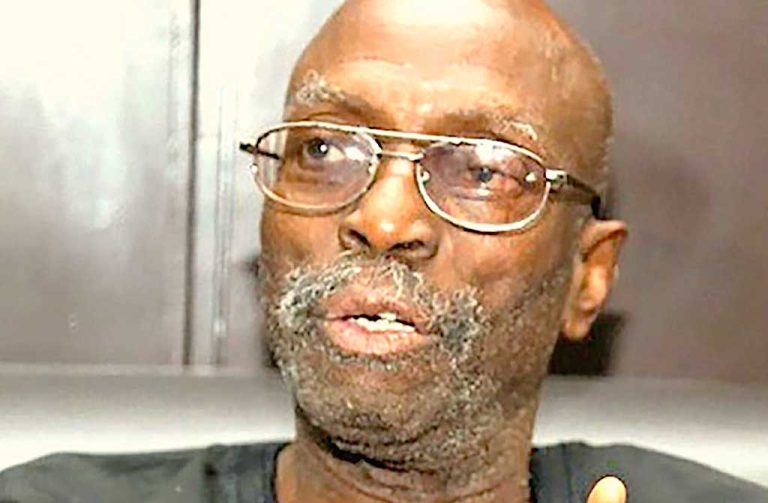
The talking drum bends low; its leather voice trembles.
An iroko has answered the call of the forest.
Professor Biodun Jeyifo has gone the way of the ancestors — not in defeat, but in fulfillment.
Eight decades he walked this red earth, measuring it with the stride of inquiry, planting questions like kola nuts in the courtyards of power.
O BJ, ọmọ ilẹ̀ Ìbàdàn, child of the dust that births stubborn thinkers,you did not come among us to decorate silence.You came with fire wrapped in grammar,with thunder disguised as scholarship.
Who now will trouble the complacent page?Who will lean into the wind of argument and call it home?In the old Yoruba way, when a great tree falls, the forest does not clap — it inhales.
It remembers the shade it gave, the birds it housed, the medicines hidden in its bark.
So we remember you: teacher of teachers, critic of critics, custodian of the word’s moral burden.Your classrooms were not bounded by walls.
From Nigeria to distant shores, from seminar halls to conference podiums, you stretched the map of African thought.
You spoke of drama as destiny, of literature as a people wrestling with history.
In your readings of Wole Soyinka, you did not genuflect; you engaged.
You wrestled brilliance with brilliance, sharpened steel against steel, and called it love — the love of truth.
You taught us that criticism is not quarrel; it is care.That to interrogate is to honor.That to disagree with rigor is to build a house strong enough to weather time.
Ah, BJ, alákọ̀ọ́bẹrẹ̀ of restless minds,you wore intellect like agbádá — ample, flowing, but never cumbersome.
Your laughter, quick and knowing, could soften the edge of your fiercest argument.Your pen, however, spared no laziness.
You insisted that ideas must earn their keep.That theory without conscience is a masquerade without a dancer.
In the marketplace of nations, where Africa is too often misread, you stood like a town crier refusing distortion. You declared that our stories are not footnotes.
That our theatre is not imitation. That our modernity is not borrowed cloth but woven aso-òkè, thick with memory.
When storms gathered around the public square, you did not retreat to ivory towers.
You walked into the square. You argued that scholarship must descend from its balcony and sit among the people.
That the academy is not a shrine but a workshop. That knowledge must carry the weight of justice.
Today, the curtain falls on your visible presence. The stage dims.
The script closes. Yet what is a life such as yours if not a rehearsal for immortality?
The elders say when a sage departs, he does not vanish; he becomes wind. He becomes proverb. He becomes that inner voice that refuses cowardice.
Already, in libraries and lecture halls, your sentences stir like harmattan dust — persistent, impossible to ignore.Nigeria mourns, yes. Africa bows its head.
The global academy lowers its flag of inquiry.
But beyond grief there is gratitude ; deep, resonant, like the bass of the bàtá drum at twilight.
Thank you for eighty years of intellectual integrity.Thank you for the stubbornness of your clarity.
Thank you for impacting us – that to think is an ethical act.
Sleep, BJ, where the ancestors debate in eternal symposium. Sit among the great disputants of our history.
Let Orun welcome you with the dignity you gave to words.
And we, your friends and admirers, named and unnamed – will keep the argument alive.
We will trouble falsehood. We will defend nuance. We will refuse easy applause.
For the iroko has fallen, yes.But its seeds are everywhere.
Go well, Professor.The drum will speak your name at dusk.
The forest will remember.
Lanre Ogundipe President, IBILE Club and former President Nigeria and Africa Union of Journalists writes from Abuja.February 13, 2026.
news
Makinde elevates Alago-oja, 13 other Oyo High Chiefs to crown wearing Obas, presents them instruments of office
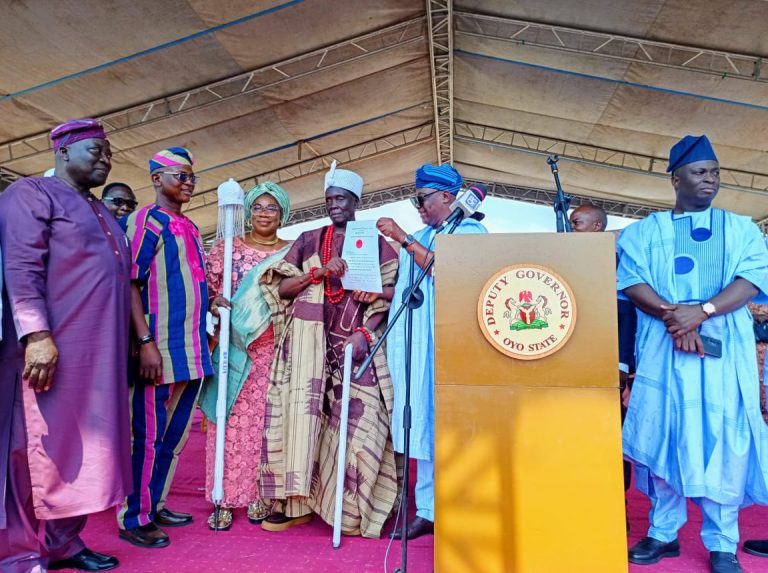
Oyo State Governor, Engr. Seyi Makinde elevated 14 High-Chiefs and Baales in Oyo town to the status of beaded crown wearing Obas, formally presenting them with instruments of office.
The coronation ceremony was held on Friday, February 13, 2026 at Oliveth Baptist High School, Oyo.
The colourful ceremony was well attended by traditional rulers, political leaders, senior government officials and traditional and cultural stakeholders from across the state.
Speaking on behalf of the Governor, the Deputy Governor, Barrister Adebayo Lawal, said the elevation of the chiefs underscored the administration’s commitment to strengthening traditional institutions and promoting peace and development at the grassroots.
He congratulated the newly crowned monarchs, noting that their ascension to the status of crown wearing Obas was both a recognition of their leadership and a reaffirmation of the enduring relevance of traditional institutions in governance, peacebuilding and grassroots community development.
According to him, the state government holds traditional rulers in high esteem because of their roles as custodians of culture, promoters of unity and partners in progress.
He urged the monarchs to uphold integrity, fairness and service to their people, stressing that their reigns should be characterized by peace, inclusiveness and support for government programmes aimed at improving citizens’ welfare in their domains.
The Deputy Governor added that the synergy that exist between government and traditional rulers remained vital in addressing security challenges, promoting unity and accelerating grassroots development.
Earlier in his welcome address, the Commissioner for Local Government and Chieftaincy Matters, Otunba Ademola Ojo, described the event as historic and culturally significant, saying it represented not just the installation of royal fathers but a reaffirmation of Oyo’s rich heritage and enduring traditions.
He said the Yoruba traditional institution, one of the oldest and most revered in Africa, remains central to governance, culture and unity in Oyo Land.
The beaded crown, he noted, is a sacred symbol of authority, service and divine responsibility, and those who wear it are called to lead with integrity, courage and compassion.
Ojo commended Governor Makinde for approving and sponsoring the programme, adding that the coronation of 14 Obas at once symbolised unity, continuity and renewal within Oyo Land.
He reaffirmed government’s commitment to strengthening collaboration with traditional rulers for conflict resolution, cultural preservation and community mobilisation.
The newly elevated monarchs include the Alaaguo of AguoLand, Oba David Oyediran; the Baba Eyaji of Oyo, Oba Afonja Mukaila; the Alajagba of Oyo, Oba Samuel Odurinde; the Ona-Isokun of Oyo, Oba Isiaka Tella-Titiloye; the Onimileke of Imileke Oyo, Oba Fakayode Alowonle; the Onigbudugbu of Gbudugbu Oyo, Oba Salawu Oyeniran; the Oloodu of Ojongbodu, Oba Olaniyi Adegboye; and the Alapa-Ara of Apa-Ara, Oba Tijani Ajeigbe.
Others are the Onidode of IdodeLand, Oba Oyeleke Yusuff; the Iba Samu of Oyo Empire, Oba Lamidi Jimoh; the Alago-Oja of Ago-Oja Land, Oba Ganiyu Busari Ajiboye; the Alakeitan of Akeitan, Oba Jimoh Oyeleye; Elepe of Iseke, Oba Abel Oyekan, and the Agbaakin of Oyo; Oba Asimiyu Jimoh.
Major highlight of the ceremony was the official presentation of instruments of office comprising the staff and certificates as well as the formal crowning of the monarchs.
Present at the event were the Olubadan of IbadanLand represented by the Asipa Olubadan, Oba Hamidu Ajibade, former Speaker of Oyo state Assembly, Senator Monsurat Sunmonu, members of 10th Oyo Assembly from Oyo geopolitical zone, top government functionaries and political leaders.
-

 news11 months ago
Interrogating the connection between social service and charity
-
news2 months ago
Arrive Early To Examination Centers, Comport Yourselves – Oyo HOS Admonishes Civil/Public Servants
-
news10 months ago
ANPP block in APC expresses deep concern over marginalisation to re-evaluate membership
-
news8 months ago
LG Commission Chairman ‘Wolekanle’ Gets Oyo NULGE’s Support
-

 economics12 months ago
NNPC Shipping, partners unveil joint venture to boost crude transport
-

 news11 months ago
Abdulrazaq Inspects Govt’s Multistorey Prototype School
-
 news12 months ago
Man arrested for beating girlfriend to death in Lagos
-

 economics12 months ago
Subscribers lament as MultiChoice raises DStv subscription by 21%